Nearer stock
- Released for collection
- Monday
- Journey
- 2 hours
First receiving opportunityTuesday 08:00
A train in the workshop is a train out of service, and the spare part it is waiting for is only useful once the maintenance depot can receive it and get it to the pit. ENVO moves railway and rolling stock components between OEM suppliers, traction depots and MRO repair centres, from a single time-critical replacement unit to a scheduled overhaul load, in Spain and across Europe.
Urgent rail spare parts
The maintenance team finds a suitable replacement at two locations. One is nearby, but the part still has to be released and packed. The other is farther away and ready now. Both are quoted from the hour the goods can actually leave, with the vehicle available at each point and the depot’s receiving hours, and that often changes which one makes sense.
First receiving opportunityTuesday 08:00
First receiving opportunityMonday 14:00
An illustrative example. Both units are approved, a vehicle is available at each point, and the depot accepts arrivals until 15:00 and opens again at 08:00.
The shorter journey reaches the depot at 16:00, after reception has closed; the longer one arrives while the team is still there. Bring the nearer part’s release forward, or agree a later receiving appointment, and the result flips. That is the comparison you get in the quote, with the depot’s own checks and the move to the workshop counted in.
One urgent item in a larger order
An urgent item does not make the whole order urgent. A replacement control unit is needed for tonight’s repair while the interior panels on the same purchase order belong to a refurbishment next month. Where the workshop can receive them separately, the priority package is quoted on its own, and you weigh the extra collection against the capacity and deadline of the full consignment. Splitting pays only when the first delivery lets the team do something; your maintenance planner decides what the complete set for the job is, and the packages released against it travel accordingly.
For the rest of the order:
Batch collections for depot maintenance
A rolling stock overhaul or refurbishment programme brings the opposite problem: several loads are ready before the depot has room for them. The receiving team wants the batches that support the next job, with later material following when it can be accepted, so supplier collections and depot deliveries are planned as a recurring milk-run round around that release plan, each batch tied to its receiving date and workshop reference.
Why a pallet count says little
Railway freight runs from a protected electronic module to a dense assembly on a transport frame, and the pallet count says little about either.
| What is travelling | What decides the transport |
|---|---|
| Electrical modules and test equipment | The supplier’s specified protection, orientation and handling limits |
| Bogie, traction, brake parts and other dense mechanical assemblies | Individual weight, supporting footprint and the loading equipment at both ends |
| HVAC, pantograph, door mechanisms and interior panels | Packed length, vulnerable surfaces and whether anything can be stacked above them |
| Workshop tools, cable drums and installation materials | The complete packed shape, its restraints or supports, and the receiving site’s access |
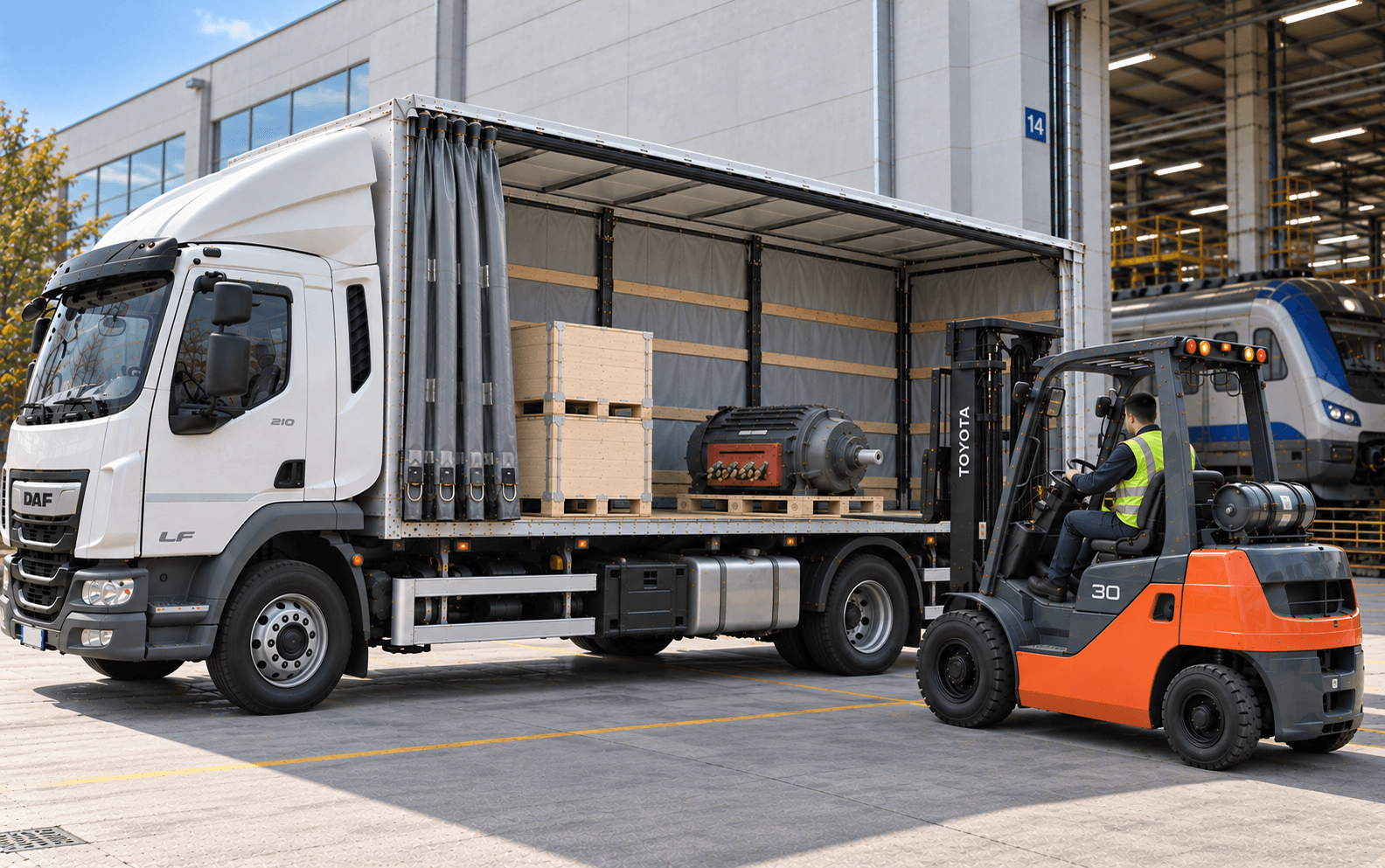
A case or a cradle changes the vehicle, so a vehicle is only sent once the exact overall dimensions of the unit as it will travel, projecting supports included, are in the request; a photograph of the packed load says more than a catalogue image of the bare component. Side loading, crane roof loading and rear tail lift or forklift unloading have to fit the same plan: a supplier’s overhead crane makes collection simple while the depot may have no way to lift the unit off, so the curtainsider or dedicated vehicle is checked against both ends. The appointed handling teams provide and operate the lifting equipment; the supplier specifies how the component is packed and supported; the transport is planned around both.
Depot access and handover
The goods entrance matters more to the driver than the depot’s postal address, so the delivery point is the actual gate and bay, with a contact who knows the delivery is coming and, where access is unclear, a map pin and the site’s current instructions.
Updated ETA, and who gets it
An updated ETA goes to the person who can still act on it, usually the depot contact holding the unloading appointment rather than only the office that placed the order; the reporting contacts are agreed at booking, and the vehicle is on GPS while it moves. If the original handover becomes unworkable, the options are the next receiving opportunity, the vehicle waiting, a revised destination or storage nearby, with the revised cost agreed with you before anything is done.
Return journeys for repair
A replacement can be ready to leave while the faulty unit is still installed, so the return has its own ready time: removal, inspection, packing, often continuing after the delivery vehicle would otherwise have left.
The rotable or repairable part going back can look identical to the one delivered, so it travels under its own serial number, linked to the RMA repair authorisation and the MRO repair centre’s address; the sending team says which unit is released, the repair centre says where it goes. Where the exchange agreement sets a date, whether it means dispatched or received changes the plan, and the supplier decides whether the returned component meets its conditions.
FAQ
Start your request
The two locations, the packed load, when it can leave and when it has to be received; the depot contact and any return, where they exist. Anything provisional is quoted as such and confirmed before booking, and where the part is approved at a second source, both are quoted.