Construction road transport and site deliveries across Spain and Europe
A building site receives goods differently from a warehouse: the gate is on another road from the postal address, the ground is not always firm, and the crane is booked by the hour. ENVO plans supplier collections, routes and timed delivery slots around the project schedule and around what the site can take, from one Euro pallet of fittings to a full truckload (FTL) trailer of building materials and frames.
What travels, and what does not
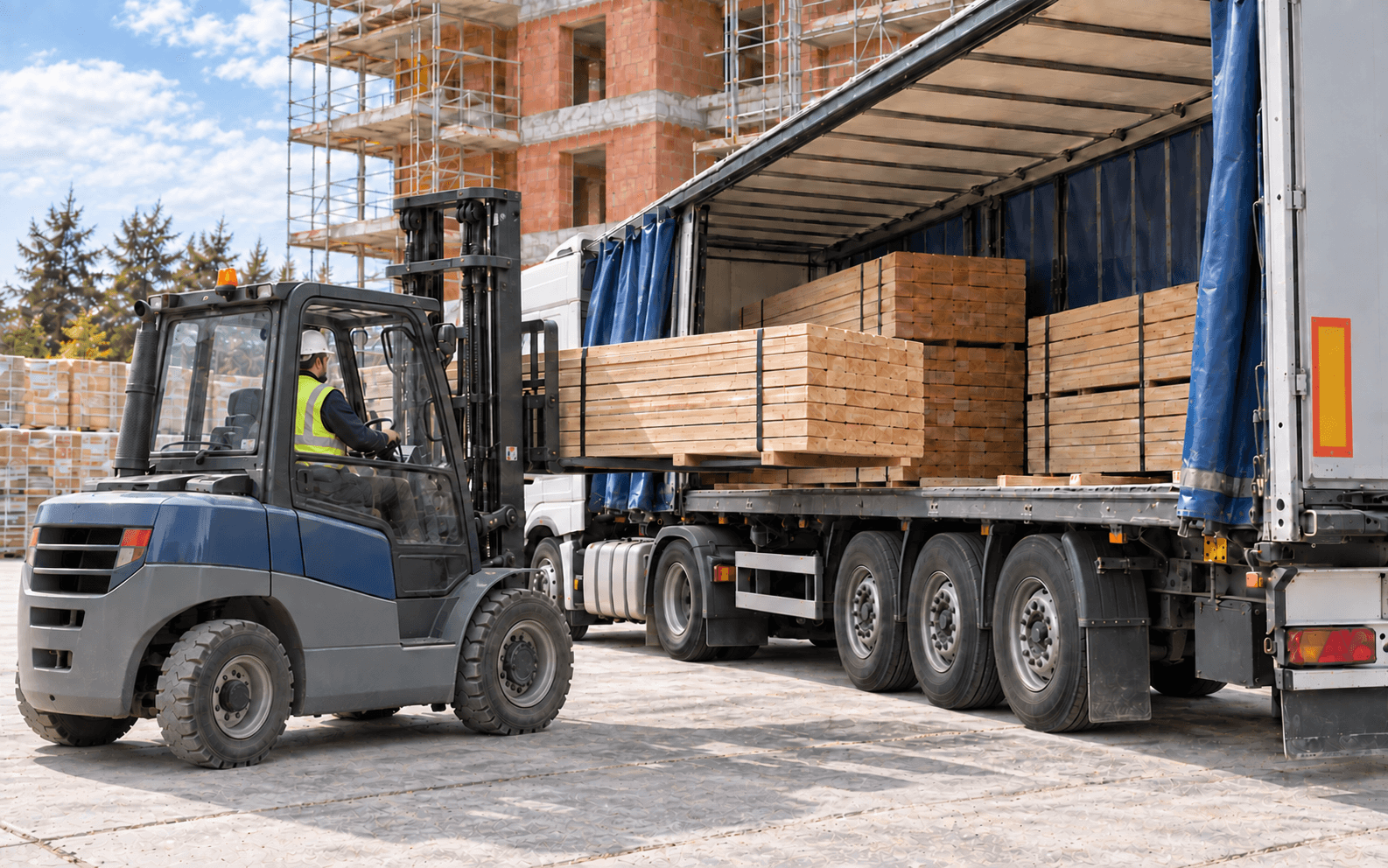
Building materials and site equipment
Packaged and palletised goods for construction and refurbishment, including items that need extra loading space or protection in transit:
- Structural timber, steel profiles, reinforcement and formwork
- Insulation, roofing products, cladding panels and window frames
- Plasterboard, pipework, ventilation components and electrical equipment
- Kitchens, doors, sanitaryware, tiles, flooring and lighting
- Tools, scaffolding and reusable site equipment
Dense materials reach the weight limit with half the floor still empty, while insulation and cladding fill the floor and barely trouble the axles. Window frames on stillages have to be lifted from above or from the side, and finished joinery takes its damage at the edges, in handling more often than on the road. With the packed dimensions, the unit weights and the handling instructions in the request, the vehicle follows.
Bulk aggregate, ready-mixed concrete and silo deliveries need tippers and mixers, which is not something we arrange. Bagged cement and packaged aggregate travel as ordinary palletised freight goods. Paints, adhesives, aerosols and other ADR products with transport restrictions travel too, with the safety data sheet (SDS) deciding under what rules.
Paints, adhesives or aerosols? See Specialised Freight
Timed to the build
Deliveries in batches, deliveries to a slot, and the urgent one
In batches, as the building is ready. A window order may be complete at the factory while only two floors can take it. Sending it all at once turns the contractor into a warehouse, with frames moved around the site until each floor is ready. Collections are arranged in batches instead, matching what the supplier releases to the installation schedule, floor by floor or section by section.
To a booked crane or just-in-time (JIT) unloading slot. The collection is planned backwards from the appointment, and the service is chosen to meet it: a dedicated vehicle straight to the site, for a part load as well as a full truckload (FTL), or LTL groupage for smaller, well-packed shipments when the receiving date has some room.
The urgent one. A replacement component or an incomplete delivery leaves an installation team standing. The starting point is the hour the missing item is needed; we check when the supplier can release it and give you the earliest feasible arrival before the express run is arranged.
One vehicle, straight to the gate? See Dedicated Transport & FTL
A few pallets sharing a vehicle? See Groupage (LTL)
An installation team waiting? See Express & Time-Critical
What the street allows
Vehicle access to the site
The gate, not the postal address. A site’s goods entrance is often on a different road from its address, so the delivery address is the gate the driver has to reach, with directions for the last turning if it is easy to miss. Before the vehicle is booked, the street is checked for weight and size restrictions and for the emission zone it falls in, so the vehicle sent is one that is allowed there.
What fits through it. Gate clearance, turning space and the surface at the unloading area decide the vehicle: express vans for smaller orders and restricted access, 7.5 t and 18 t rigid trucks for more, 13.6 m articulated vehicles for large loads where the approach allows them. Long items may need side or crane roof access through a curtainsider.
When the road is not finished. A photo of the entrance usually tells us whether a truck can get in at all, and what size. If the driver finds it different on arrival, the vehicle stops and the site and our office are called before anything is unloaded.
Which vehicle fits your gate? See Our Vehicles
Who takes the goods off
Unloading and the delivery point
The site has a forklift or crane. The arrival is planned with the receiving team and time is allowed for the unloading. The equipment and its operator have to be free when the vehicle is there, and any crane lift is arranged by the site.
The site has none of that. A vehicle that unloads itself: a tail lift and a pallet truck handle palletised goods, provided the pallet truck can get from the vehicle to where the goods are being left, which rules out loose gravel, soft ground and steps. On an active site that place is often the entrance or a finished surface rather than the working area. Where the weight of a unit or the state of the ground rules that out too, you hear it before the booking, not at the gate.
The last few metres
Where the delivery ends
Choose a handover point to see what it needs and who takes the goods on from there.
When the floor is not ready
Storage before delivery
Sometimes the supplier has to release an order before the site has room for it. The materials are collected when the supplier wants them gone and held at a warehouse near the site, for days or weeks, with onward delivery when the floor is ready; storage, handling and the last leg are quoted together, as part of the transport.
If the site schedule changes after a delivery has been booked, what happens next depends on where the goods are. Before collection, the date moves with the supplier. On the road, the options are the vehicle waiting, a new date, or storage nearby, and any additional cost is agreed with you before anything is done.
Nowhere to put it yet? See Warehousing
Before the vehicle leaves
Deliveries across customs borders
On a route that crosses a customs border, the clearance is part of the transit time, not something running alongside it. The goods description, the value and the commercial documents are needed before the vehicle leaves, because a missing figure on an invoice stops the load at the border, not in the office.
Tools, formwork and reusable site equipment that go out to a project and come back afterwards travel under their own customs procedure, a temporary export or an ATA Carnet for professional equipment, so they return without import duty or VAT. It starts with the declaration on the outbound journey, which is why it is worth knowing at the quote stage that the equipment is coming back.
Crossing a border with the load? See Customs Clearance
FAQ
Frequently asked questions about construction site deliveries
Start your request
Your project’s deliveries, in one quote
The collection and delivery addresses, what the goods are and the dates you are working to. You get back the vehicle, the unloading arrangement and the price, confirmed before anything is booked.