Trade fair, exhibition and event road transport across Spain and Europe
A trade fair does not move its dates, and the exhibition hall admits vehicles only twice: before the doors open and after they close. Both windows are run on vehicle passes, unloading time slots and a queue at the gate. ENVO plans both outbound and return road journeys around them, from Spain to exhibition venues and congress centres across Europe, inside the EU and outside it.
Before the road matters
From venue access to unloading
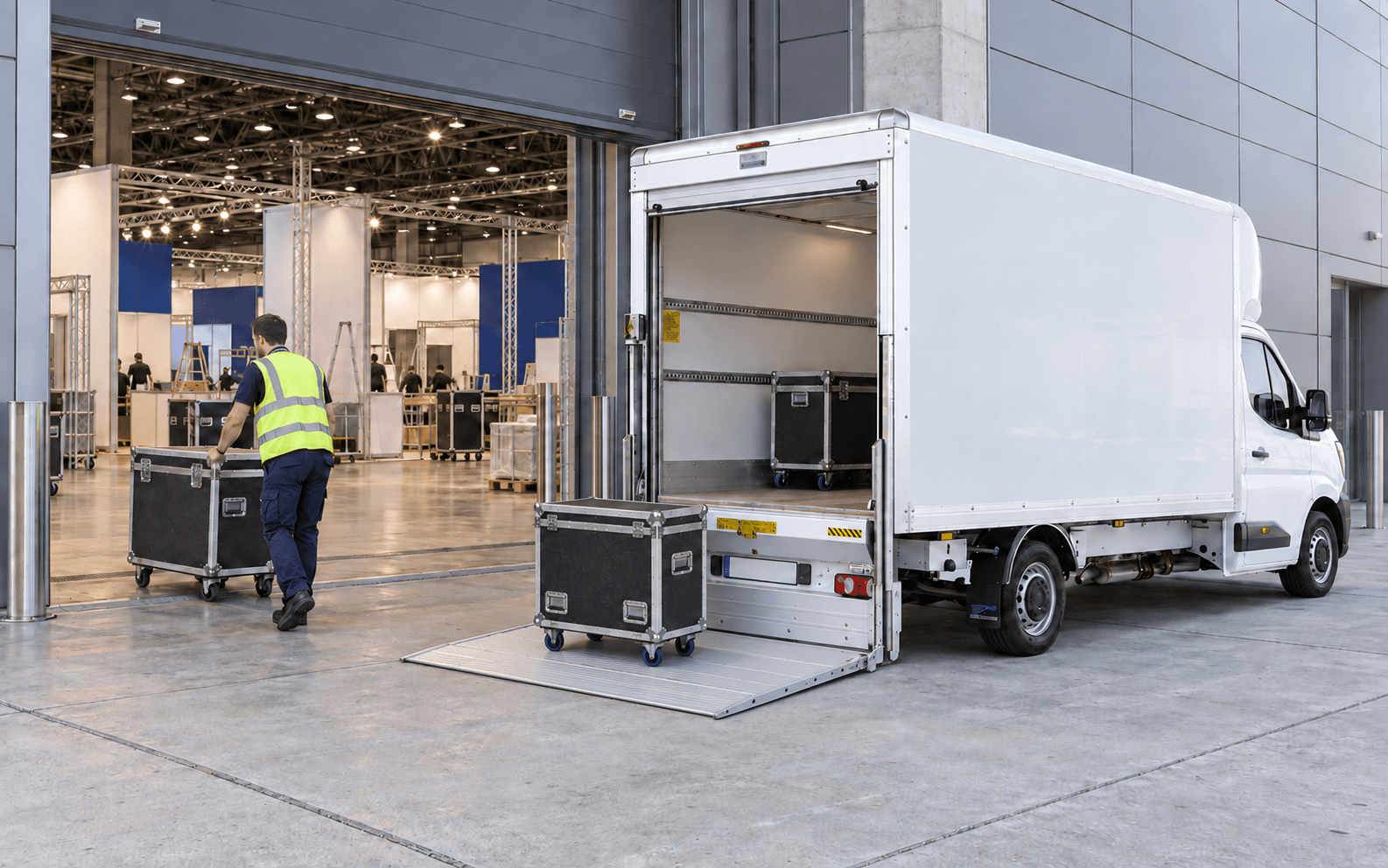
Every large venue runs its own traffic regime during the build-up, and it decides the morning more than the road does. The vehicle is registered in advance, reports to a holding area outside the halls and is called to a bay when one is free. It then has a fixed time to unload, from 30 minutes to 4 hours depending on the venue and the vehicle, after which a fee, a lost deposit or a tow truck follows. Inside the hall, forklifts are reserved to the venue’s contractor at most European trade fairgrounds, so the driver unloads palletised cargo and flight cases to the hall door with the tail lift and a pallet truck, and from there the official on-site handler or your own crew takes the exhibition stand to its position.
The registration, the pass and the slot are the exhibitor’s, issued through the exhibitor manual; with them in the cab, the vehicle finds the holding area, docks when called and is loaded so that the time on the ticket is enough. Those three things are what decide whether the stand is on the floor by the first morning of the build-up.
Between the two journeys
What happens to the empties during the fair
Once the stand is built, the crates, flight cases and packaging have to leave the hall, at most venues by the evening before opening, and nothing comes back in until the fair closes. For a short fair with a dedicated vehicle, the empties leave with it and return with it for the dismantling. For a longer fair, or when the vehicle is needed elsewhere in between, we arrange secure empties storage near the venue for the days of the fair, as part of the transport, and the empty crates and cases are back at the hall door when the doors close. Either way it is settled with the quote, so nobody is looking for the crates on the last evening.
Nowhere to put the empties? See Warehousing
Closing night onwards
From dismantling to the journey home
Dismantling runs in a fixed order, and the vehicle has to arrive inside it. Hand-carried goods leave the hall first, then vehicles are admitted, usually 1 or 2 hours after the last visitor and at some venues only the following morning. A vehicle that sets off from home that evening meets a closed gate and a queue, so the vehicle assigned to your stand waits in the holding area before the show closes, loads through the night and leaves with the stand.
What happens after that is decided by the calendar as much as by the distance. Most of the countries between the venue and home close their roads to vehicles over 7.5 tonnes on Sundays and public holidays, which is when fairs tend to end. France makes an exception for material travelling to or from an event held within four days; Germany, Austria and Italy make none, and Switzerland adds a night ban on top. A van or a 7.5 tonne truck is outside the bans and drives home on Sunday; a trailer waits until Sunday night. We read the closing date against that calendar before quoting, so the day the stand is back at your premises, in storage or at the next fair is a date you have in writing.
Build-up and dismantling
Two windows at the hall door
Choose a window to see how the vehicle gets from the holding area to the hall door, and what decides its time there.
Two kinds of exhibitor
For stand builders, and for the company with one stand a year
A stand builder in the season has several stands moving at once, often in different countries, and judges a carrier on whether the vehicle is free for the next venue while the crew is still building this one. We work to the build calendar: collection days fixed at the workshop, structure, graphics, tools and furniture loaded in the order the crew will want them, and the vehicle either released or held for the empties, whichever the fair requires.
A company that exhibits once or twice a year has a different problem. There is no crew at the hall door, the exhibitor manual runs to dozens of pages, and its traffic rules are written for people who do this every week. What we need from it is short: the vehicle pass, the slot if the venue books one, and the hall and stand number. With those, the vehicle arrives where and when the venue expects it, and the driver unloads to the hall door or, where the venue allows, to the stand. Where you have appointed a stand builder, the delivery window is agreed with them directly, so the stand and everything that goes on it arrive together.
Chosen by the venue too
Which vehicle goes to which venue
Event loads run from a few flight cases for a hotel launch to a trailer full of stands for one fair, and the vehicle is chosen by the venue as much as by the load.
| Load | Vehicle | Why |
|---|---|---|
| Samples, graphics, a few flight cases | Compact van, up to 2 pallets | City venues and hotels without a dock; outside the international driving-time rules |
| A small stand, AV equipment, furniture | 3.5 t van with tail lift, up to 5 pallets | Congress centres with no loading bay; unloaded inside the venue’s time limit |
| A full stand with structure and graphics | 7.5 t truck with tail lift, up to 14 pallets | Outside the Sunday driving bans in Germany, France and Italy |
| Several stands, or one large exhibit | 13.6 m trailer, up to 33 pallets | One vehicle for a stand builder’s whole fair |
Full specifications on the Our Vehicles page.
Out and back, duty free
Across a border with an ATA Carnet
A stand going to a trade fair in the United Kingdom or Switzerland travels on an ATA Carnet, the temporary admission customs document that lets exhibition goods and commercial samples enter a non-EU country and come back without paying import duty or VAT. The carnet belongs to the exhibitor and comes from the Chamber of Commerce; the vehicle stops for customs on the way out and on the way back, and the driver presents it at each stop. Since June 2026 the carnet can be digital, shown as a code on a phone, on routes where every country has adopted it; where one has not, the paper booklet travels in the cab as well. We prepare the customs side together with the transport and tell you at the quote what the list should contain and which items cannot travel on it.
A fair outside the EU? See Customs Clearance
Weight against value
Cover for a load that is light and valuable
Compensation under the CMR Convention is calculated by weight, at a fixed sum for every kilogram lost or damaged, currently around 10 euros. The formula fits cargo whose value follows its mass, and it fits a trade fair badly. A flight case of demonstration equipment can weigh 200 kilograms and be worth 30,000 euros, and the convention alone would answer for about 2,000 of that. A 1,200 kilogram stand carried at 60,000 € in your books would be covered to roughly 12,000 €.
That is why every event shipment we carry is also covered by Goods in Transit insurance of up to 100,000 €, which answers for the AV equipment, flight case and the exhibition stand at their real value. Above that figure, or for pieces that need their own cover, two things close the gap, both settled before the vehicle is loaded: the cover extended for that journey to the value you give us with the request, or an exhibition policy of your own, which has the further advantage of covering the goods during the days on the stand, when they are in nobody’s keeping but yours. We ask what the load is worth at the quote stage, so the decision is made then and not after a claim.
Where our part ends
What is included, and what is not
- Included: the two journeys, the driver at the holding area on time, the unloading inside the venue’s time limit, to the hall door or to the stand where the venue allows, and the empties in between, with storage near the venue arranged for each fair at a partner warehouse, as part of the transport.
- Not included: the vehicle registration, the pass and the slot, which the venue issues to the exhibitor, and anything inside the hall: the stand is built by your crew or your stand builder, and the forklift belongs to the venue’s contractor where the venue reserves it.
- Throughout: one team follows both legs, from the first call to the return, with the fair’s file in front of them.
Three things
What a quote for a fair starts from
Three things: the fair, the dates of the build-up and the dismantling, and the size of the stand in pallets or cubic metres. If you have the first two and can describe the third, that is enough. What comes back covers both journeys, the days between them and what we propose for the empties, at a price fixed before anything is booked. The hall and stand number, the vehicle pass, the slot and, for a fair outside the EU, the carnet come in at booking, once they exist.
FAQ
Frequently asked questions about trade fair transport
Request a quote
What needs to move, and when?
The essentials are below; extra details help refine the quote.
Start your request
Two dates, two journeys, one quote
The fair, the venue and the dates of the build-up and the dismantling. You get back the vehicle, the days and the price for both legs, confirmed before anything is booked.