Road transport for ingredients, food and beverage freight across Spain and Europe
A missing ingredient can hold up food production. A late replenishment can leave a retail promotion without stock. ENVO arranges ambient, chilled and frozen road transport for food and drink producers, distributors and retailers, from urgent express consignments to planned full truckload (FTL) and groupage deliveries. The product’s transport specification, the quantity ready to leave and what the receiving customer will accept: those three decide the vehicle and the service.
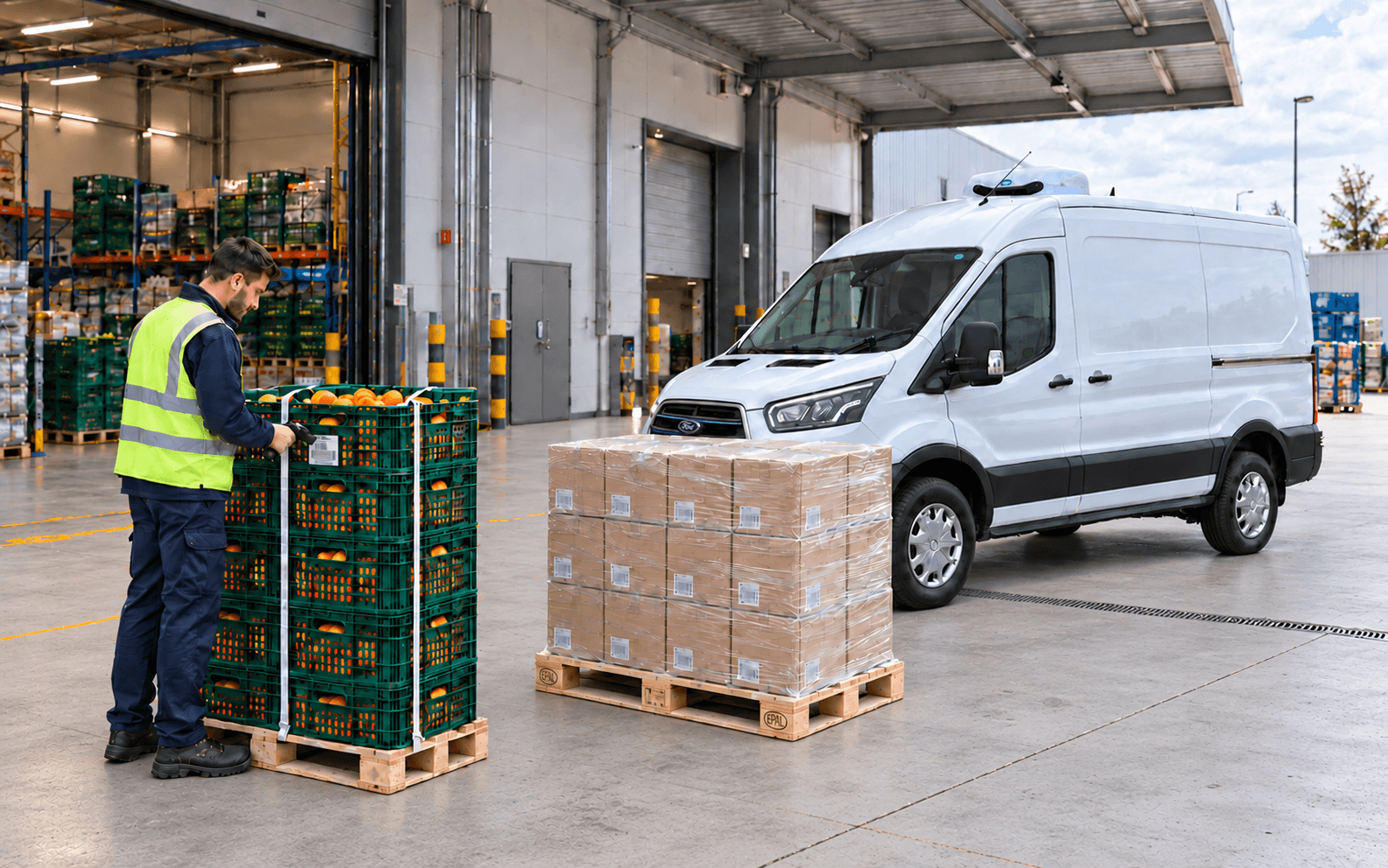
What six pallets does not tell us
Start with the product specification
“Food products, six pallets” tells us how much space to consider. It does not tell us whether the cargo needs refrigeration, protection from freezing or separation from another product. The product description and its transport specification, alongside the packed dimensions and weight, decide which vehicle and service fit the load.
| Product requirement | What changes in the transport plan |
|---|---|
| Ambient | Packaged dry goods and drinks still have storage and handling limits. Any sensitivity to heat, cold, moisture or odours belongs in the specification; “ambient” is not unrestricted exposure. |
| Chilled | The required positive temperature range, the cold-chain collection conditions and the monitoring requirements set the arrangement. Different chilled and fresh products may need different ones. |
| Frozen | The required deep-frozen conditions and the receiving checks set the arrangement. ATP-certified equipment and its availability are confirmed for the particular load and route. |
The product name alone is not enough. A shelf-stable sauce and a fresh sauce may look similar on a pallet but need different conditions in transit. The specification that counts is the one for the goods as they will travel.
Ambient and temperature-controlled goods can be quoted in the same enquiry. With the requirements for each line of a mixed order, it is clear what can travel together and what needs an arrangement of its own.
Two orders, a single setting
Can these batches share one temperature zone?
Two orders are ready at the same factory and going to the same customer. Combining them looks straightforward until their transport specifications are compared. The space may be available, but a single temperature setting has to suit every product assigned to that zone.
Two fictional batches: Batch A requires +2 to +6°C; Batch B requires +4 to +8°C. Their declared intervals overlap between +4 and +6°C. Add a frozen batch with a declared interval of -22 to -18°C, and there is no temperature common to all three. Turning the setting down cannot resolve that conflict; only a second zone or a second vehicle can.
- Batch A
- Within range
- Batch B
- Within range
Shared temperature interval: +4°C to +6°C
Illustrative shipment specifications. Temperature-range comparison only. Load suitability still requires assessment.
The overlap is only the first check. Packaging, contamination risks, odours and the loading arrangement are checked next. Even a common interval does not establish that one compartment is suitable or that its equipment can maintain the required conditions throughout the load.
With the complete product list in the enquiry, it is clear before booking whether one temperature setting covers the load. Where it does not, a bi-temperature (dual-temp / multi-temperature) reefer van or truck can be arranged, with two independent temperature zones on one vehicle; each zone’s capacity and availability are confirmed for the actual load and route. Where two zones are not enough, or none is available on the route, the goods travel as separate movements.
Days remaining at receipt
Protect the shelf life the customer is buying
A batch can be within its date and still fall short of a buyer’s acceptance terms. Some customers require a minimum number of days remaining at receipt; others apply a percentage of the product’s original shelf life. That commercial requirement belongs in the transport enquiry, alongside the delivery deadline.
It is checked against the actual batches being released, not against the order as a whole. An order assembled from several production dates may have different receiving limits within the same load. The earliest collection is of little value if the selected stock will already be outside the customer’s agreed terms when it arrives.
The choice between a direct journey and a consolidated service starts with which dates the receiver uses and how it counts them, with the planned journey and the receiving appointment added on top. Where inspection or release is needed before the goods can enter stock, that time counts as well.
If loading moves to tomorrow, the batch dates move with it. A revised vehicle booking does not automatically preserve the original acceptance margin. We can review the transport options; the sender and buyer decide whether the proposed batches still meet the order. Product safety and suitability remain separate from this commercial calculation.
Urgent part now, balance later
Match the service to the order that needs moving
For an ingredient shortage, the quantity that lets production restart, and the hour it is ready for collection, are what set the plan. A smaller, complete consignment may justify an express vehicle while the balance follows on the planned delivery. The useful quantity is the one the production team can actually use, with its batch identification and required documents.
Small shipments still need the right conditions. A temperature-controlled van may suit an urgent load, subject to its packed size, weight, specification and availability. If the supplier loads only from a raised dock, or the customer needs a tail lift, that also affects the choice.
For regular movements, ENVO can quote a delivery pattern around production releases and customer orders. The usual volumes, collection days and seasonal changes are what shape it. A drinks launch may need extra capacity before its first store date; a food manufacturer may need smaller, more frequent ingredient deliveries because its receiving storage is limited. A useful schedule reflects those constraints.
LTL groupage deserves a closer look for ambient products when the timetable allows it. What decides it is compatible food-grade freight, intermediate handling, transit allowances and receiving terms. Chilled and frozen products do not travel by groupage: they go on a dedicated or express vehicle that holds their temperature from loading to handover. For sensitive loads or a fixed appointment, a dedicated movement may be more appropriate even when the vehicle is not full.
There is a physical limit as well as a timing decision. Bottled drinks can reach a vehicle’s weight limit before its floor space is filled. Bulky, light food packs can present the opposite problem. Gross weights and packed measurements, pallets included, say more than a pallet count alone.
One consignment that cannot wait? See Express & Time-Critical
Room on a shared vehicle? See Groupage (LTL)
A vehicle for this load alone? See Dedicated Transport & FTL
Cooling, release and repacking
The loading bay is part of the journey
Goods travel under the conditions agreed for collection. If the batch is still cooling, awaiting quality release or being repacked, the collection slot moves with it: it reflects when the load can actually leave, with the checks and paperwork completed.
For temperature-controlled and perishable goods, the loading procedure is agreed between the dispatch team and the carrier. This includes the vehicle’s pre-cooling and preparation, the core condition of the product and how the cold-chain transfer from cold storage will be managed. The journey does not correct a product that leaves at the wrong temperature.
Airflow, packaging and stop order
Leave room for the load to travel properly
Refrigerated loading needs to respect the equipment’s airflow requirements. Pallet height, wrapping, spacing and position can affect the proposed arrangement. Loading to every visible gap is not a sound capacity assumption. The finished pallet dimensions, and any instructions on how the goods may be positioned, are what the arrangement is built on.
Packaging has its own job. Glass bottles need protection from movement and contact; cartons need support that respects their stacking limits. Non-stackable pallets and overhangs belong in the enquiry, before the quote. A photograph of the finished load is particularly useful when the product is fragile or its packaging is unusual.
For several delivery points, the loading order also matters. Goods for an early stop need to be accessible without repeatedly moving later deliveries. Empty crates, trays or pallets collected on the round count as part of the load: their condition, space and separation are checked before they join food.
Which body takes the pallet? See Our Vehicles
Setting, air and product are three answers
Know what the temperature record measures
The refrigeration setting, recorded air temperature and a product temperature measurement answer different questions. A screenshot of the setting does not describe the whole journey, and an air record is not a measurement of every package.
If the receiver requires a temperature record, the evidence it expects is settled before booking. We confirm the monitoring and reporting available for the proposed movement, including any shipper-supplied logger arrangements. The record is tied to the shipment and to the period it covers. Who receives it, and who is called when a reading or an event needs a second look, is settled at the same time.
What a distribution centre looks at
Make the handover easy to check
At a food distribution centre, the receiving team may check the order reference, quantity, batch dates, packaging and temperature before accepting a delivery. The site’s requirements, known early, are what the handover is planned around. An appointment in the booking system needs to match the vehicle, goods entrance and unloading arrangements on the ground.
The documents let the receiver connect the pallets to the order without opening a new investigation when the product and batch references match across the dispatch list and the pallet labels. If different batches sit on one pallet, the allocation is written on it. Any required seal reference is with the receiving team as well.
For a restaurant, shop or site without a loading dock, where unloading ends, and who moves the goods into the appropriate storage, is agreed in the booking. Access, handling equipment and the receiver’s availability all belong in the booking. A driver arriving at the street address does not establish that the handover can be completed there.
If the receiver raises a concern, preserve the facts first. Record the affected goods, reason, time and available readings or photographs. Tell us which quantities have been accepted and which remain on the vehicle. We coordinate the next transport step with the parties involved while the responsible food business assesses the product. The goods stay under the agreed transport conditions while instructions are obtained; if they cannot be held that way, you hear from us at once.
A return, redelivery or holding arrangement needs a confirmed destination and suitable conditions. Nearby warehouse space is not automatically suitable food storage. Any additional movement, waiting or storage is agreed for these goods in particular, not for freight in general. The driver’s receipt and the buyer’s release of stock for use are different decisions.
Enough to start, and what sharpens it
Request a quote for the complete movement
Three things are enough to start: what the goods are, where they travel between, and when they are ready. What follows makes the quote exact rather than approximate.
- The goods: product description, packed dimensions, gross weight, packaging and transport conditions for each part of the load.
- The collection: address, batch ready time, loading method and any release checks still outstanding.
- The delivery: destination, deadline or appointment, unloading facilities and the receiver’s acceptance requirements.
- The additional work: monitoring evidence, extra stops, returns or border formalities that need to be included.
FAQ
Frequently asked questions about food and beverage transport
Start your request
What a quote starts from
For a recurring flow, the normal volume and the peaks you already know about shape what we quote: the vehicle, the pattern and the price, confirmed for the movement. Where an ingredient shortage or a stock gap makes the delivery urgent, the quote starts from what has to reach the customer first.