Table
- 1 of 3Top
- 2 of 3Base
- 3 of 3Fittings
Complete
A load of chairs fills the vehicle long before it reaches the weight limit; a stone-topped table does the opposite. Furniture is judged on the surface it arrives with, so the vehicle, the packing and the last few metres to the room are planned together. ENVO moves finished commercial, retail and contract furniture between manufacturers, distribution centres, showrooms and hotel or office fit-out projects, from a single bespoke piece to a full truckload (FTL).
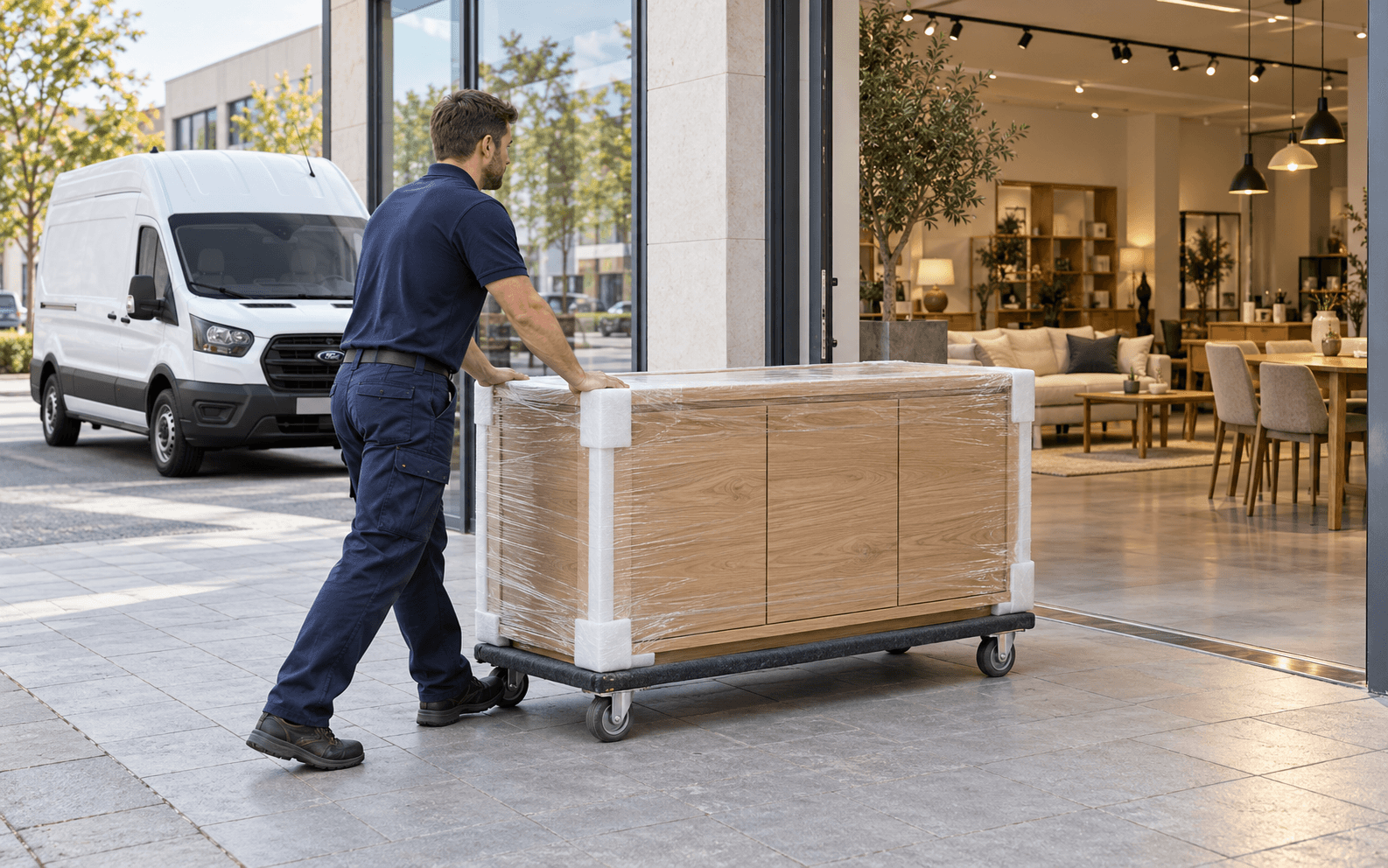
Three destinations, one order
The same order can be going to a retail distribution centre, a showroom or a hotel or commercial space being fitted out, and each destination changes how the load is prepared and delivered. Upholstered seating, tables, beds, cabinets and joinery and other finished pieces travel as a single collection, as recurring stock movements or in batches planned to a hospitality or contract fit-out schedule. What connects them is the same: what the supplier has ready, matched to the space, the equipment and the people waiting at the other end.
For the existing contents of a home or an office, the Removals service is the one built for it, with loading crews included.
Moving what is already in the room? See Removals
The parcel, not the catalogue
Upholstered seating fills a vehicle before it troubles the axles; flat-pack cartons do the reverse and put weight on a small footprint. The vehicle is chosen on the packed dimensions, the unit weights and what can be stacked, pallets, crates and projecting supports included, not on the catalogue, which describes the assembled piece rather than the parcel that travels. Three things decide most of it:
What stays upright and what takes weight on top. A flat carton is not necessarily a shelf for another one; a piece that cannot be stacked owns the space above it, and that space is part of the price.
The largest unit. A long tabletop, a tall cabinet or a stone-topped base has to pass through the loading opening and suit the handling equipment at both ends. Its weight and shape can decide the vehicle even when the rest of the order is straightforward; a photograph or a packing drawing settles it in a minute.
The manufacturer’s packing instructions. They say where a finished surface or an unsupported panel must not take pressure, and the load is built to them.
Will the largest piece fit? See Our Vehicles
Space or weight
Choose an order to see the same truck loaded, and which runs out first: the space or the payload.
Complete item by item
A table is a top, a base and a fittings box, and the packing list is what ties the three to one item, one order and one destination. Labels like “1 of 3” need a shared reference, or two sets from the same range become one set of six.
That matters on the day only part of the order is ready. A table in three cartons and a chair in one: if the base is missing, the chair is complete and the table is not. The supplier or the installer decides what can be used on its own; the transport then moves the complete items now and the rest when they exist, or waits for the full order, and you see both prices.
Complete
Complete
Illustrative example
At handover, the package count and any visible damage to the packaging are recorded; what is inside a sealed carton is not, so the supplier remains responsible for the contents and for confirming that the released packages make up the order.
For several rooms or addresses, the destination goes on every outer carton. A product code says what the piece is, not where it belongs, and when identical items are split between locations, each receiving team gets the references for its part.
Damaged in handling, not on the road
Furniture is damaged in handling far more often than on the road, so the packing is decided before the vehicle is:
On a dedicated vehicle, furniture blankets, straps and corner protection are part of the equipment. A display piece that has spent a year on a showroom floor usually needs fresh packing before it travels again; with a few photographs, what has to be done is known before collection, not at it.
Where the address stops being enough
“Delivery to the hotel” can mean a loading bay, a service entrance or a room on the fourth floor, and the address alone does not say which. The quote does: it names the handover point, who carries from there, and with what.
Ground-level handover, carrying inside, unpacking, positioning and assembly are separate parts of a delivery, and the quote says which of them are included and who supplies the people. Where your own team takes over at the door, the handover point and their hours go into the plan.
A piece the ordinary vehicle will not take? See Specialised Freight
Floor by floor
Contract furniture and FF&E (furniture, fixtures and equipment) follow the progress of the fit-out: the first floors are ready while another is still a work area, and everything delivered at once ends up competing for space with trades and materials. Phased deliveries are planned in batches instead, to the areas the project team has released, each batch labelled by destination area and receiving contact before it leaves the supplier.
Opening sealed packs, sorting mixed orders and distributing pieces around the building are agreed separately when you want them.
A delivery date and an installation date are usually two appointments, with time between them for the receiving team to check and place the packages before assembly starts. Where installation has to follow the same day, the installers’ hours go into the plan, and the quote says whether the transport fits them.
The date that moves
A room release slips, a lift booking moves, an access restriction appears. Before collection, the release is simply held at the supplier. Once the goods are on the road, the options are the vehicle waiting, a new handover date or storage nearby, chosen on the likely delay and on what the furniture can stand, with the revised cost agreed with you before anything is done.
Nowhere to put it yet? See Warehousing
One door short
A replacement cabinet door, a table base or a panel damaged in the factory holds up an otherwise finished order. With the supplier’s replacement reference and the packed details, a separate urgent movement is quoted against the installation appointment, so you can weigh the extra transport against waiting for the next planned delivery.
If the original piece has to go back, its ready time is often different from the replacement’s, even at the same address, and both are planned together; where the replacement’s packaging is to be reused for the return, that is settled with the supplier before it is thrown away.
Needed before the installers arrive? See Express & Time-Critical
Off the floor, and back
Display furniture moves between branches, goes back to the supplier or on to a buyer after its time on the floor. Its condition is recorded before packing, existing marks and detached parts included, with photographs against the item reference, so what is collected is what is delivered and nobody argues later about a scratch that was already there. Packed for the road and reachable when the vehicle arrives, it travels like any other piece.
A return needs the supplier’s receiving address and return reference, which often differ from the original dispatch, and whether it is going back for inspection, repair or resale decides how it is handled; damage that affects handling is described up front. We move it; the supplier decides the commercial outcome of the return. Empty reusable cases and transport supports go back the same way.
FAQ
Start your request
The addresses, the packed size and weight of each item, and where exactly the handover happens; a packing list covers most of it. You get back the service, the vehicle, the handover arrangement and the price, confirmed before anything is booked.