Quotation and booking
The pieces, sizes, weights and stackability are confirmed together with the access at both addresses, the collection and delivery windows and any extras such as a tail lift or a booked time slot.
When your shipment doesn’t fill a truck, you shouldn’t pay for the empty deck space. We combine compatible palletised and part loads travelling in the same direction, across Spain and Europe.
Why it costs less
Groupage (less than truckload) is the cheaper way to move commercial goods that don’t fill a vehicle; you pay for the floor space you use, not the whole deck.
The saving comes from sharing, and sharing takes a little time. Your freight waits for the next departure on its route and travels with other shipments going the same way, which usually adds a day or two. If your delivery date has room in it, that is time well traded for a lower price.
Pallets, crates and drums
Groupage works best for freight packed as a stable handling unit that can be moved with standard warehouse equipment:
The finished dimensions, weight and stackability of each unit determine the space required and form the basis of the quote.
Pricing
Space and weight set the base price. The rest comes from the route and the details: the distance, how much freight moves in each direction on that corridor, and extras such as a booked time slot or an address far from the main routes. Routes where return freight is scarce carry a higher rate per loading metre in one direction than in the other, and that shows in the quote rather than behind it.
Step by step
Four clear stages keep the shared journey understandable from the start.
The pieces, sizes, weights and stackability are confirmed together with the access at both addresses, the collection and delivery windows and any extras such as a tail lift or a booked time slot.
A vehicle with the agreed equipment collects within the window. Every package should travel labelled with its destination and piece count, which keeps the shipment together while it shares space with others.
Your freight is grouped with shipments heading the same way and dispatched with the next departure on that route. On some routes it changes vehicle once at a cross-docking consolidation point, moved by forklift or pallet truck.
The goods arrive within the agreed window, to ground level or a loading bay depending on the address, and proof of delivery (POD) follows the handover.
Our vehicles
With groupage, you book space, not a vehicle. ENVO operates groupage services with vehicles from 7.5 tonnes upwards. A 7.5 tonne truck carries 14 pallets, against eight in a 3.5 tonne van, which gives us the capacity to combine several shipments travelling in the same direction. On higher-volume routes, a standard 13.6 metre trailer carries 33 Euro pallets.
Capacity is not limited to the vehicle floor. Depending on the body type, an internal height of between 2.6 and 3 metres accommodates pallets up to 2 metres tall, and shorter pallets that are packed and approved for stacking travel two high, so one floor position carries two pallets and every departure works harder.
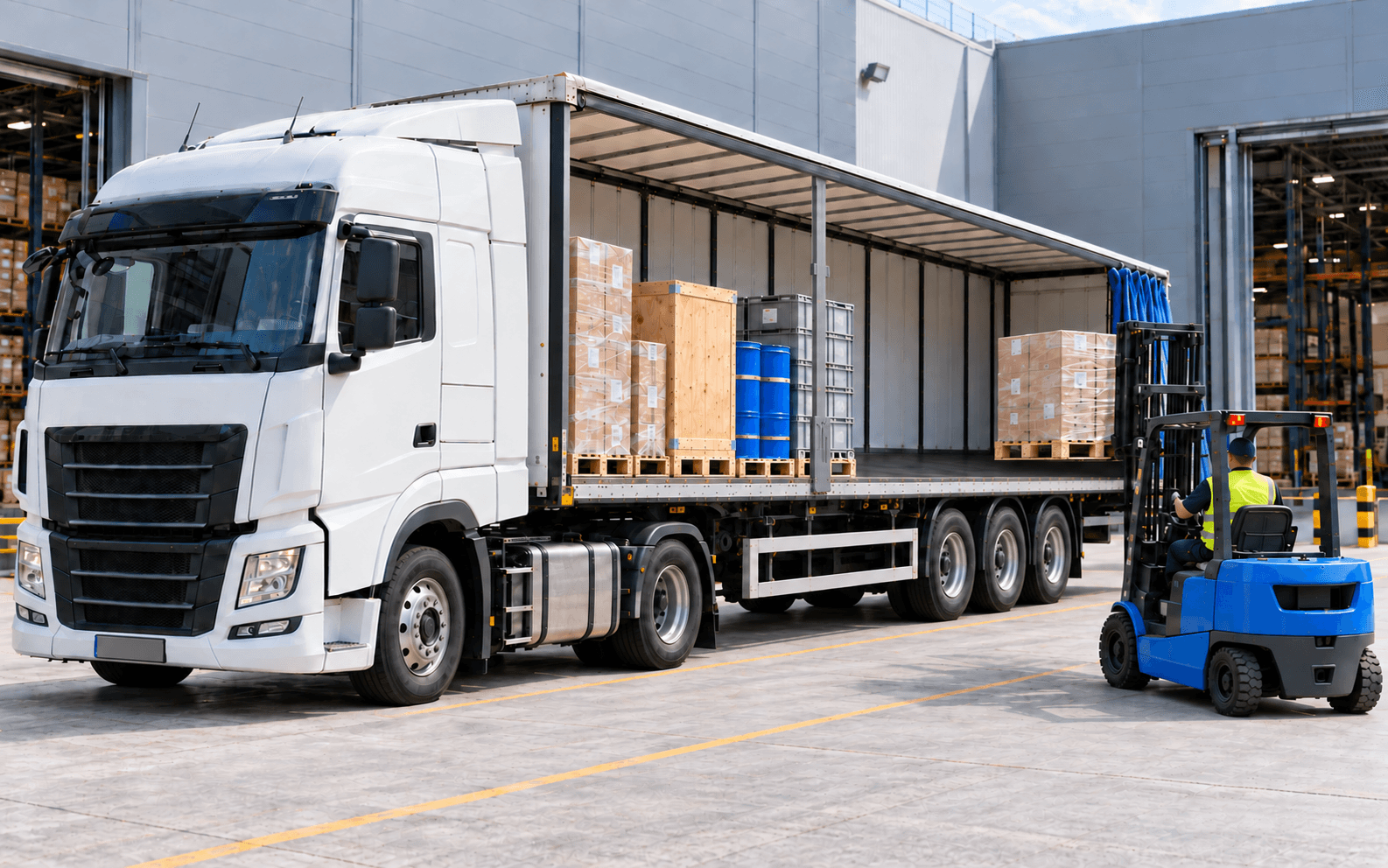
Palletised freight also remains a single handling unit. At equipped sites the complete pallet is loaded and unloaded by forklift, and where there is no loading bay or forklift a vehicle with a tail lift lowers it intact to street level. Keeping the goods together on the pallet limits individual handling and helps protect the shipment throughout its journey.
Access decides which of them can come. A 13.6 metre unit needs a yard it can turn in and a bay to back onto. A 7.5 tonne truck reaches town centres, workshops and industrial units that larger vehicles cannot, and where the address has no bay or forklift it arrives with a tail lift, which brings a pallet down to street level on firm, level ground. Kerbs, gravel, slopes and narrow gateways are worth mentioning with the request, because they are settled more easily before the vehicle is assigned than at the door.
Before collection
In a shared vehicle your goods travel next to someone else’s, and on some routes they change vehicle once along the way, so packaging does more work than in a dedicated load. Goods should sit inside the footprint of a sound pallet, without overhang, wrapped or strapped to it, with edge protection where the straps bite. Fragile pieces need packaging that can take normal forklift handling; the sticker warns, the packaging protects. Anything that cannot carry weight should be declared at booking and marked.
Labelling is what keeps a shipment whole while it travels in company: every package should carry the delivery address and its place in the count, 1 of 3, 2 of 3 and so on. If you are unsure about any of this, send photographs of the packed goods with your request and we will tell you whether they are ready for a shared load.
For an accurate quote
Dangerous goods always travel on a dedicated vehicle, never in a shared load.
Start your request
With the collection and delivery addresses, the number of pieces and their type, the size and weight of each, and whether anything can be stacked on top, the space, the window and the price for your route follow.
You will get the space, the window and the price for your route, itemised so you can compare it line by line.
In transit
Groupage routes do not all generate the same information. ENVO confirms the visibility available on the chosen route before booking rather than using ‘real-time tracking’ as a blanket promise. Depending on the service, this may include collection confirmation, updates at key milestones, an updated delivery window and proof of delivery.
If continuous GPS visibility, a named handover contact or a booked delivery time is essential, include it in the request. We will confirm whether the groupage route can support it or recommend a dedicated service that can.
Coverage
ENVO coordinates road groupage on domestic Spanish and international routes across Europe, in both directions, and beyond the EU where the route and the customs conditions allow. Frequency follows the corridor: the busiest routes turn around quickly, while others run through consolidation points and need a day or two more. The realistic window for your destination, and the collection date needed to meet it, are part of the quote rather than a surprise after it.
Once a route crosses the EU customs border, a shared vehicle becomes a set of individual customs entries: every shipment on board is declared and cleared on its own. Each entry stands alone, and the vehicle leaves when the last of them clears, which is why complete paperwork on a groupage load is worth more than it looks. We prepare the transport alongside these formalities, so the goods and their documents are ready on the same day.
Customs on a groupage route? See Customs Clearance
FAQ
Practical answers for planning part loads and shared vehicle capacity.
Request a quote
The essentials are below. Sizes, weights and whether the freight is stackable are what turn a range into a price.